The shorter the education, the bigger the gap between women and men in work
The shorter the education, the bigger the gap between women and men in work
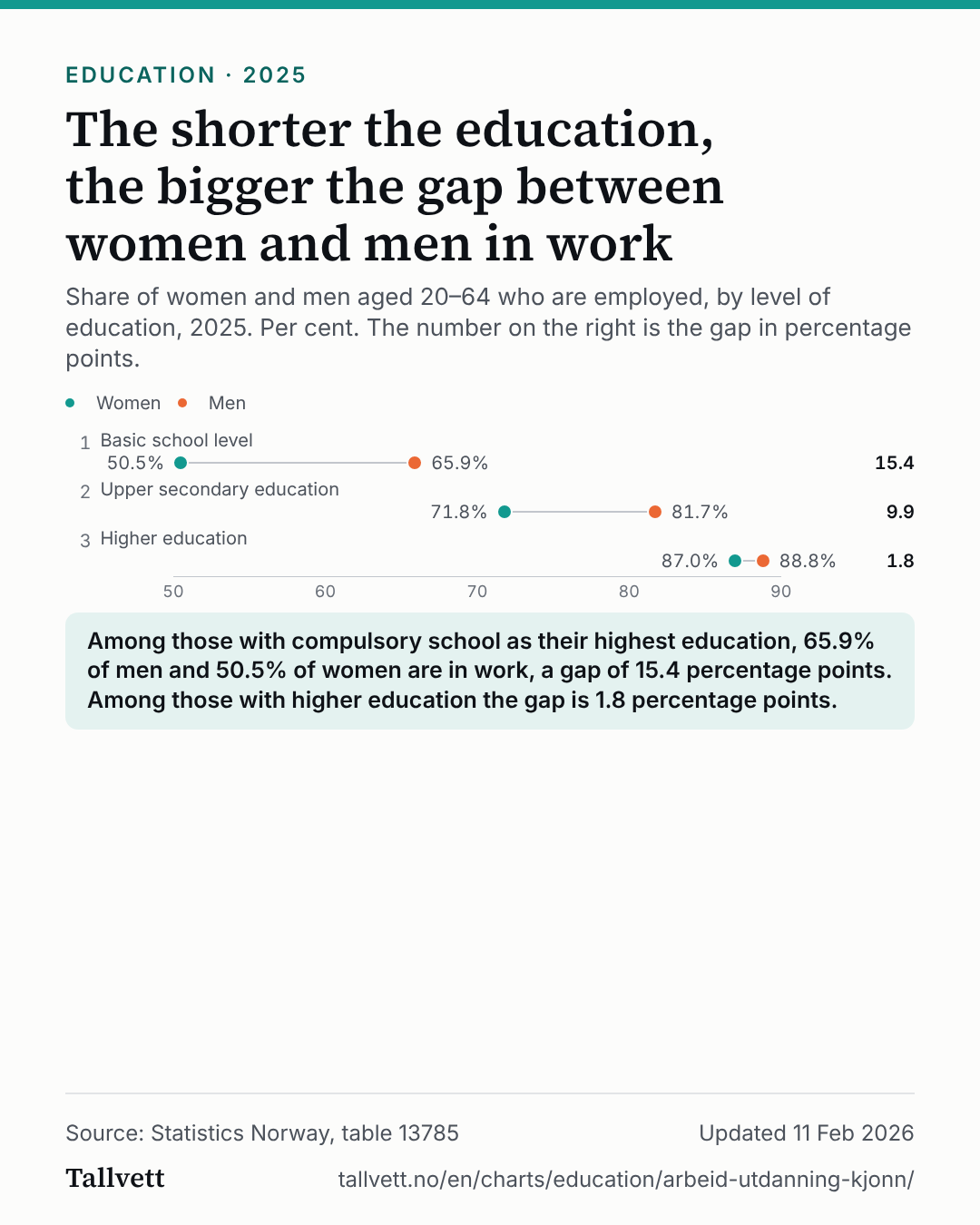
Share of women and men aged 20–64 who are employed, by level of education, 2025. Per cent. The number on the right is the gap in percentage points.
Share of women and men aged 20–64 who are employed, by level of education in 2025. Basic school level: women 50.5%, men 65.9%, gap 15.4; Upper secondary education: women 71.8%, men 81.7%, gap 9.9; Higher education: women 87.0%, men 88.8%, gap 1.8.
WomenMen
- Basic school level15.4Women 50.5%, Men 65.9%, 15.4
- Upper secondary education9.9Women 71.8%, Men 81.7%, 9.9
- Higher education1.8Women 87.0%, Men 88.8%, 1.8
Among those with compulsory school as their highest education, 65.9% of men and 50.5% of women are in work, a gap of 15.4 percentage points. Among those with higher education the gap is 1.8 percentage points.
Show the figures as a table
| Level of education | Women | Men | Gap |
|---|---|---|---|
| Basic school level | 50.5% | 65.9% | 15.4 percentage points |
| Upper secondary education | 71.8% | 81.7% | 9.9 percentage points |
| Higher education | 87.0% | 88.8% | 1.8 percentage points |
How this chart was made
- The shares are Statistics Norway's own, from table 13785: employed persons as a share of all persons aged 20–64, for women and men at each level of education. We have not calculated them.
- The gap we calculated: men's share minus women's share, in percentage points. The rows are sorted by it.
- Level of education is the highest completed education, as Statistics Norway groups it in three levels. Persons with unknown education are not included.
- The figures do not show why the shares differ. Age, immigration and health, among other things, may play a part.
Statistics Norway's notes on the table
- As of 11 February 2026, tables by level of education were revised. For persons aged 18-24 with an education level below upper secondary, information from the questionnaire is now prioritized over register data.